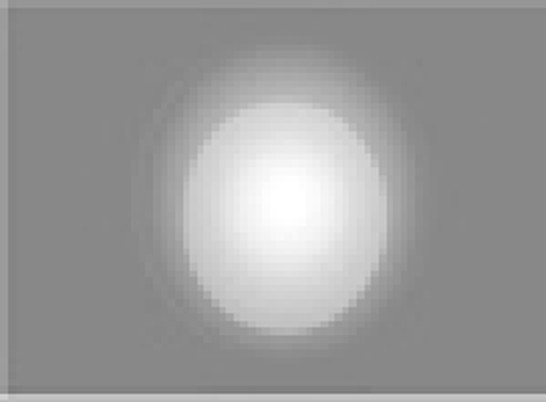

No Diffuser
Visible source, sharp beam edge, hard hotspot. This is the problem you are solving.
Low-Iron Stippled Diffusion Glass
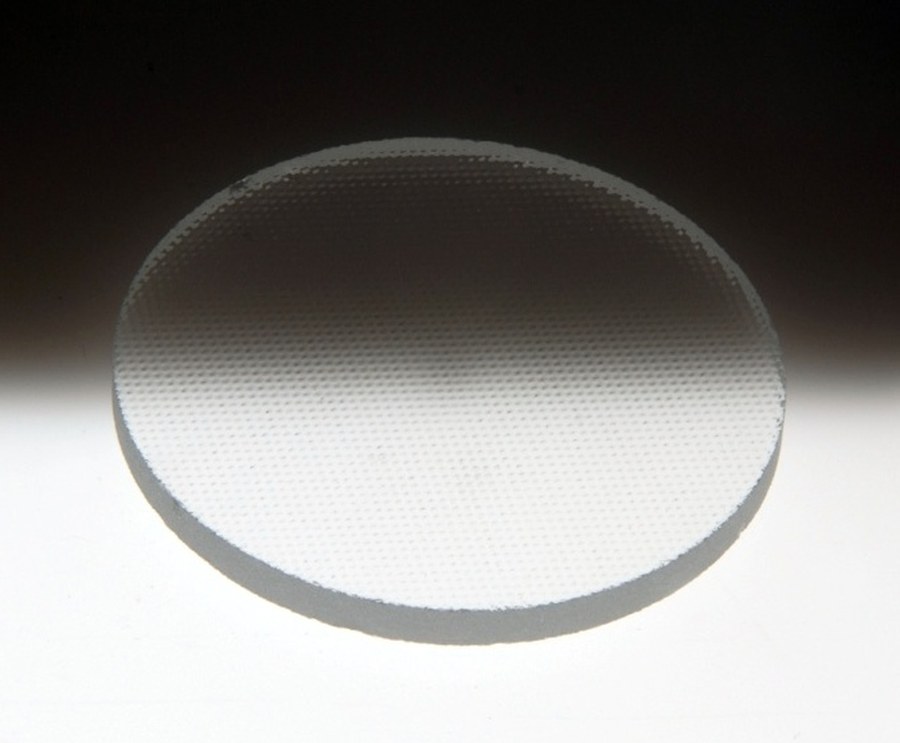
Solite is a low-iron rolled glass with a fine stipple pressed into one surface. It scatters the beam just enough to erase hotspots, striations and visible LEDs — while still passing more than 90% of the light. We fabricate it to your print.
What It Is
Solite is a rolled glass, not a float glass. Molten glass passes between textured rollers that press a fine, symmetrical stipple into one face while the opposite face stays smooth.
That matters more than it sounds. The diffusion is structural — it cannot wear off, flake, delaminate, or wash away, and it is consistent sheet to sheet when you are building a hundred identical fixtures.
Because the glass is low-iron, it also stays out of the way optically. Ordinary glass carries a green cast from iron oxide in the sand, and it gets worse as thickness increases. Solite is made from sand with roughly a tenth of that iron content, so a 3000K source stays 3000K on the other side. If you are lighting merchandise, artwork, food, or paint samples, that is not a detail — it is the whole job.
Solite sits at the gentle end of the diffusion range. It is a softening diffuser: it smooths the beam without radically reshaping it. If you need to hide a source completely or throw light much wider, there are heavier patterns — compare them below.
Specifications
Everything listed is standard. If your drawing calls for something outside it, send it anyway — almost every part we make is custom.
Working from a legacy drawing? Send it as-is. You do not need to redraw anything or process an engineering change to get a number back.
| Glass type | Low-iron soda-lime, rolled |
|---|---|
| Pattern | Symmetrical stipple, one surface |
| Light transmission | 90%+ |
| Thicknesses | 1/8" (3.2 mm) · 5/32" (4 mm) · 3/16" (5 mm) |
| Maximum size | 48" × 120" |
| Heat treatment | Fully temperable |
| Coatings | UV blocking · dichroic color |
| Stock rounds | MR11 (1.370" dia.) · MR16 (1.965" dia.) |
| Fabrication | Any shape within max sheet — round, notched, radiused, drilled |
Diffusion Comparison
Pick the gentlest option that solves your problem. The panels below show the same source bare, through Solite, and through a heavy frost — Solite removes the hotspot while keeping the most light.
No Diffuser
Visible source, sharp beam edge, hard hotspot. This is the problem you are solving.
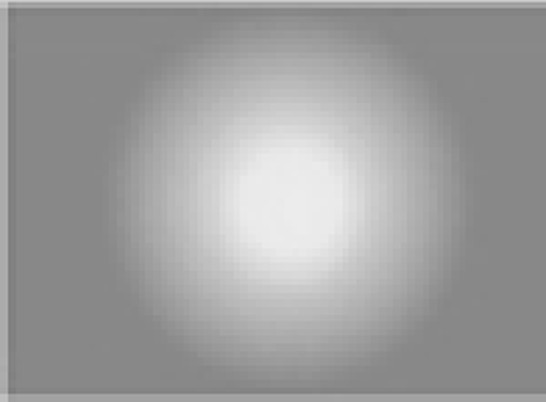
Solite Softening
Blends striations and lamp images and evens the hotspot, while largely preserving the beam you already designed.

Heavy Frost
The source disappears entirely and the lens becomes a uniform luminous surface — at a real cost in transmitted light.
Not sure which?
Send a photo of the glare, your LED pitch, and the distance from board to lens. If a gentler pattern will do the job with less light loss, we will tell you.
Request SamplesHow Solite Compares
They trade off against each other on one axis: how much of the source you hide versus how much light you keep. Solite sits at the efficient end.
Scroll the table sideways to see all columns →
| Material | How it scatters | Hiding power | Light kept | Watch out for |
|---|---|---|---|---|
| Solite stippled glass | Texture rolled into one face at manufacture | Low–moderate | Highest — 90%+ | Won't fully hide a tightly packed LED array up close |
| Acid-etched / satin | Chemically eroded surface | Low–high, by grade | High to moderate | Grade names aren't standardized between suppliers |
| Sandblasted | Abrasive-roughened surface | Moderate–high | Moderate | Rough surface traps dirt, oils and cleaning residue |
| Opal / white diffusing | Scatters through the full thickness of the material | Highest | Lowest | Large transmission loss — that's the mechanism, not a defect |
| Ceramic frit | Printed pattern fired into the surface | Tunable by dot density | Varies with coverage | Pattern is often visible when the fixture is off |
Published transmission figures vary widely by grade, thickness and test method. The 90%+ figure is ours and we will send a sample so you can verify it.
If you are working from an older drawing you may see prismatic, linear or fluted callouts. Those optics are not obsolete — micro-prismatic is everywhere in modern LED panels, and it is how UGR<19 office fixtures control glare. But it moved to injection-molded plastic, where the tooling economics and geometric precision beat what rolled glass could deliver.
The rolled-glass versions faded with the lamp sources they were designed around. If your print calls one out, you are effectively choosing between a molded plastic equivalent — with the yellowing and heat trade-offs that carries — and a different glass approach. Send us the drawing and we will walk through both.
Try the cheapest lever first, because almost everyone skips it:
Applications
Anywhere someone can see the fixture and shouldn't be able to see the source.
Softening the beam and hiding LED arrays in architectural fixtures. The application Solite was specified into for decades.
Demand is consistent enough that both diameters are stocked as rounds — 1.370" and 1.965".
Retail and grocery cases, where the lens sees real temperature swings and the merchandise has to look right.
Evening out a source mounted close behind the panel, without the yellowing a plastic face would show in year five.
High-cycle, high-visibility, expensive to access. Exactly the case where a lens you never replace pays for itself.
Paired with a UV blocking coating where the light must not damage what it is lighting.
Glass vs. Plastic
Plastic diffusers cost less up front and fail in three predictable ways. They yellow, as UV and heat break down the polymer. They scratch, so every cleaning cycle adds haze. And they deform near a hot source, bowing and pulling out of their retainers.
None of it happens fast enough for anyone to notice it happening. It just means the fixture looks wrong in year six — and yellowing is not reversible. It is a change in the material, not dirt on the surface.
Plastic still wins on weight, on impact resistance, and on complex molded geometry. If the lens is going to get hit by a basketball, use polycarbonate. If the fixture needs to look correct in twenty years, use glass.
How many times will this lens be replaced over the life of the fixture, and what does it cost to reach it each time?
Request a Quote
A drawing, a sketch on a napkin, an old lens you want matched, or just dimensions and a description of the problem. We quote custom work every day — one prototype or a production run.
Your request is in. We usually reply the same business day.
If you have a drawing, email it to info@soliteglass.com and we will match it up. In a hurry? Call 888-567-4527.
Questions
A low-iron soda-lime rolled glass with a fine stippled pattern formed into one surface during manufacture. The stipple scatters transmitted light to eliminate hotspots, striations and visible lamp images while transmitting more than 90% of the light that reaches it.
The original mill that produced Solite is no longer in operation, which is how most people end up here — they went to reorder and found their source gone. The material is still available. We fabricate it to print, in any quantity, including tempering and coatings.
It depends on the effect you want. Stipple toward the source generally gives a softer, more uniform glow; stipple facing out preserves more of the beam's original character. Order samples and try both — then state your choice explicitly on the drawing, because a fabricator has no way to guess.
Ask one question: can this glass ever be hot and then get hit with something cold? Outdoor fixtures, wash-down environments, food service and greenhouses all say yes. Tempering also changes the break characteristic to small, relatively blunt fragments, which some applications require by code.
There is no single best — it depends on whether you care more about efficiency or concealment. Stippled glass like Solite keeps the most light and softens without reshaping the beam. Opal hides a source completely but costs the most light. Acid-etched sits in between with grades to choose from. See the full comparison.
Acid etching chemically erodes the surface into a smooth satin finish; sandblasting mechanically roughens it into a granular one. Acid-etched is more uniform and resists fingerprints, which matters on anything people touch or clean regularly. Sandblasted is cheaper and easier to mask for patterns, but its open surface traps dirt and oils over time.
Yes. Send us the old part, or its dimensions and thickness. This is a common request when a plastic lens has yellowed and the original fixture manufacturer no longer supports it.
No. We quote single prototypes for design reviews and full production runs from the same shop. Every part we make is custom, so quantity changes the price, not whether we will take the job.
Maybe not. A lot of these drawings were written around halogen and incandescent lamps, and LED assemblies behave differently — the source is usually closer to the lens and made of discrete points rather than a filament. Send the drawing over and tell us what you are running now. If a different pattern serves you better, we will say so.